About
About the Coalition
We are owners at Jamacha Greens — a condo complex with 192 units and essentially zero online presence. This Coalition exists to establish that presence: to promote transparency and ease of access to our documents and timelines, to empower informed decision making, and to make it so owning our home means owning our future.
Behind the title: the lawn by the Amistad Ct pool at sunrise, photographed by an owner just after seven on the morning of August 31, 2026.
What the record shows
Many of us live onsite, yet we feel miles away from the decisions being made and the reasoning behind them.
When the governing documents sit in a box, it helps nobody. Homeowners are left confused about their rights and the context of their surroundings. The Board is rendered unable to effectively communicate the reasoning behind its decisions. Rumors abound, trust is impacted, and communication is severed.
There is no individual we can blame for this. We can blame processes and the obscurity surrounding them. When processes feel unknowable, they feel unchangeable.
But the rules that govern us are knowable, and they are changeable. We have to seek out the knowledge and we have to seek out the change. And that change cannot be arbitrary — we have to understand things as they are before we can decide the first thing about what should change.
When facts are unavailable, folklore fills the gaps. In its research, this Coalition has found folklore to be an ineffective gap-filler. So, the facts must be made available.
“Nothing ever changes around here.”
This is true, and the explanation is straightforward.
At the annual meeting of February 15, 2024, the Inspector of Elections certified 192 members entitled to vote and 51 ballots returned. Quorum was 98, so the ballots were never opened and the sitting directors stayed. The next cycle was cancelled outright: the January 2025 minutes record that no candidacy forms came in at all. In December 2025, five owners stood for five seats, and no document we hold says how that meeting ended. In 2026, four. Of the election cycles we can document, none ended with an owner’s ballot actually being counted.
We are not being silenced or ignored. We are being agreeable. Nothing has changed because nothing has reached a vote — and nothing has removed our power to make a vote happen. The solution to the problem of “we want change” is well-defined. We simply need more people to nominate candidates and submit ballots. Every time we do not meet quorum, we collectively tell the board that we are fine with things as they are.
- Know Your Rights: How a Board Actually Changes
“The board is always the same people, and they hold all the votes.”
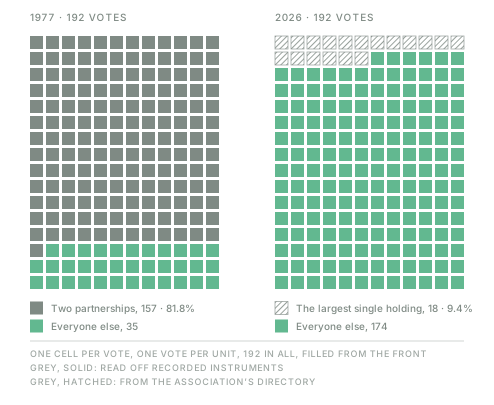
Records show that some of our board members come from families that were buying and selling units here in the 1970s, and the Association's own resident directory lists more than one unit under two of the five directors' names. This is a strategic advantage for those members, not evidence of any wrongdoing, and it does not change the path forward.
Organization is difficult among owner-occupants who hold one unit each. Under Bylaws Article II, Section 1 each owner has one vote for each unit owned, so it takes ten of us to match the voting power of a single owner with ten units. The same directory says how far that goes here: 138 of the 192 units belong to someone who owns exactly one, and the largest holding is 18. Meeting that challenge is one of the reasons this Coalition exists. An owner of ten units is not impossible to persuade. They may have just as many questions about transparency and financial accountability as a single-unit owner, and they certainly pay ten times the dues.
Two of the five seats were filled in May and June 2025 by appointment, under Bylaws Article IV, Section 7, which lets the remaining directors fill a vacancy. It does not require a vote. The time to vote is during an election. If we do not nominate more candidates than there are seats, or if we do not submit enough ballots to make the election happen at all, the seats get filled by appointment.
Nothing in the city, county and state records we have read shows misconduct by any director; what those records show is clerical. The facts say there is no shortcut to changing the board. Nominate candidates, ones with platforms — if we can come up with better ideas for how to run this place, then let us come up with them.
- Know Your Rights: How Directors Are Supposed to Be Chosen
“Our dues are too high — it must be illegal.”
Dues went up 20% for 2026, from $549.60 to $659.52 a month — the most Civil Code § 5605(b) lets a board add without a vote of the members. Our CC&Rs allow a maximum 10% increase, and the Civil Code wins: § 5605(b) applies “notwithstanding more restrictive limitations placed on the board by the governing documents,” § 4205(a) says that wherever the governing documents and the law conflict, the law prevails, and the board’s own 2023 assessment notice told owners as much.
Our dues are high because our costs are high. Our costs are high because our dues were too low for too long. For years the association put about half of what its own reserve study called for into reserves, and the shortfall reached $1,353,177. We can lament that decision and the burden it places on people who have only recently become owners here. But lamenting the decision will not change the past, and repeating the same decision certainly will not help the future.
Maintenance costs what it costs, and it must be done. As owners we are all responsible for it, as we should be. The questions worth asking are practical ones: Where is the money going? When will the necessary work be done? These are questions that can be asked and answered with numbers and dates. If we find those answers to be insufficient or unobtainable, then we arrive again at the same conclusion: nominate candidates, force a contested election, and provide better answers.
- Know Your Rights: Assessments: Why Dues Went Up 20%, and What to Ask Now
Sources: Report of Inspectors of Election, Lisa Schwartz, February 15, 2024; Regular Session Minutes, January 16, May 22, June 26 and October 23, 2025; Notice of Annual Meeting and Election, HOA Elect CA, for the December 3, 2025 meeting; Notice of Annual Meeting & Election of Directors, HOA Elect CA, for September 17, 2026; Bylaws Art. II § 1; Bylaws Art. II § 2; Bylaws Art. II § 3; Bylaws Art. IV § 7; CC&Rs Declaration J; Assessment Increase notice, Jamacha Greens HOA Board of Directors, August 31, 2023; FY2026 Annual Budget Report and Annual Policy Statement, November 1, 2025, including the Reserve Study Executive Summary; the San Diego County Recorder's grantor–grantee index and published obituaries, for the board members' family histories; Corporation Grant Deed, File/Page No. 364671, Book 1975, with its Exhibit "A", and Corporation Grant Deed, File/Page No. 400472, Book 1976, with the consent pages of the Restated Declaration of Restrictions, File/Page No. 527902, Book 1977, for who held the units in 1977; Jamacha Greens Resident Directory, Pernicano Realty & Management owner portal, read September 14, 2026, for who holds them now.
How we got here
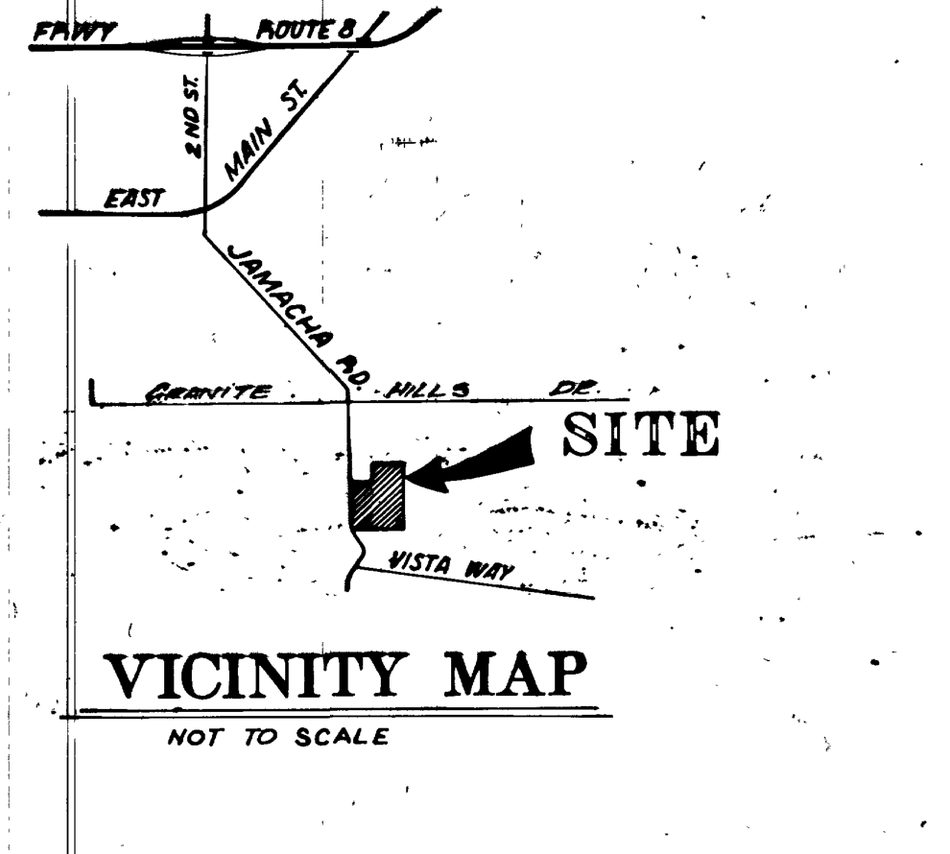
Jamacha Greens runs largely on documents written in the early 1970s. The Declaration was recorded on March 31, 1972 and restated on December 21, 1977; the Bylaws were adopted in 1971. The Rules and Regulations — the most flexible of the bunch — were last revised in January 2011.
Our board has five seats. Every seat must be held by an owner, and with very few exceptions, every owner is eligible. The board can revise the Rules and Regulations on its own, without a vote of the owners — and the newest revision we hold is dated January 2011, more than fifteen years ago.
Changing the Bylaws is a much tougher matter: an amendment takes owners representing 75% of the total voting interest, and 75% of 192 is 144. With that in mind, it is plain to see how voting for board candidates who align with your interests is the most straightforward route to effective change.
Sources: Restated Declaration of Restrictions, File/Page No. 527902, Book 1977; Bylaws Art. II § 2; Bylaws Art. II § 3; Bylaws Art. IV § 1; Bylaws Art. IX; Rules and Regulations, revised January 2011; Election Rules § 2.1.2, for who may not stand.
What one owner can actually do
None of this needs the board’s permission, a lawyer, or a hero. Most of it needs a stamp.
- A ballot counts the moment it arrives, marked or not. Civil Code § 5115 treats each ballot the Inspector receives as a member present for quorum. Sign the envelope, send the ballot back blank if you have no view, and you have moved the count. How to return yours so it counts.
- A failed meeting is not the end. If 98 do not arrive, § 5115(d) lets a properly noticed reconvened meeting proceed on 20%: 20% of 192 is 38.4, so it takes 39. The 51 owners who returned a ballot in 2024 were twelve past that number without knowing it. How elections work here.
- Ten owners can call a meeting. Corporations Code § 7510(e) lets 5% of members call a special meeting of the membership: 5% of 192 is 9.6, so it takes 10. What that meeting can do.
- The seat is a described job. Five directors, three to transact business, a monthly packet to read, a season of deadlines each fall, and a legal standard written for volunteers. Standing for it is one form by the deadline. What the job involves and the form.
- The records are yours to ask for. Minutes, the budget, executed contracts, the membership list — § 5200 names them and § 5210 sets the clock. The letters, ready to send.
What we are trying to do
Nobody living here chose these documents. An association, incorporated by the builder four days after the subdivision map was recorded, handed the owners of 192 units a corporate structure they had no part in designing. We publish accurate information about how it is governed, so that owners can make informed decisions about it. Every factual claim on this site names its source, and wherever possible that source is a document the association itself produced.
The point is a place where enough owners know how the association works to take part in it. Enough, here, is 98.
How we handle facts
- Every factual claim names its source and its date.
- We distinguish between what the law requires, what the documents say, and what we think.
- We do not characterize anyone. What a document records a person doing, with its date, is all we publish about them.
- A finding in the board’s favor goes up as prominently as one against it.
- If we get something wrong, tell us and we will fix it.
What we are doing
- Now
Publish the record
The governing documents, transcribed and searchable; a dated timeline built from the association’s own papers and the public record; and what California law adds on top. It exists. It is not finished, and it will not be.
- Now
Show the job, and who holds it
Who sits on the board and how each of them got there is on the governance record. What a seat actually involves is on its own page. Nobody can decide to run for a job they have never seen described, or to vote on a board they cannot name.
- Now
Ask for the records
A written request under Civil Code § 5200 for the minutes since October 2025 and the election materials went to the Association by certified mail on August 30, 2026. Minutes from November 2025 to August 2026 came back on October 22. Still missing: the minutes of April 23, 2026, which the Board approved in May, and the election records, which the managing agent referred to the Inspector of Elections. What comes back is published. So is what does not.
- Next
Count who is out there
Build a real count of owners who want to be kept informed. Nothing here works without knowing that number, and nobody holds it — including us.
- Then
Move as a group
Give members distinct roles, decentralize site management, and turn the coalition into an election engine.
- Then
A contested election
More candidates than seats, whoever they are, and 98 ballots. That is a secret-ballot election under Civil Code § 5100 rather than seats filled by acclamation under § 5103 or by appointment for want of a field. If owners use what is here to vote against us, that counts as success.
What taking part looks like
Mostly reading, and some of it is a good time. Someone reads a budget beside someone who has read the last three. Someone photographs a notice board. Someone finds a 1971 drawing of this place in a City archive, or a 1974 rental ad for a two-bedroom here at $195 a month. Someone mails one envelope. Nobody has to attend anything, and nobody is asked for money.
Contact
Corrections, questions, documents, or a desire to be involved: coalition@jamachagreens.com, or add your name.
Owners here also talk to each other in the Jamacha Greens Facebook group. Several of the documents on this site came from neighbors who posted them there.